

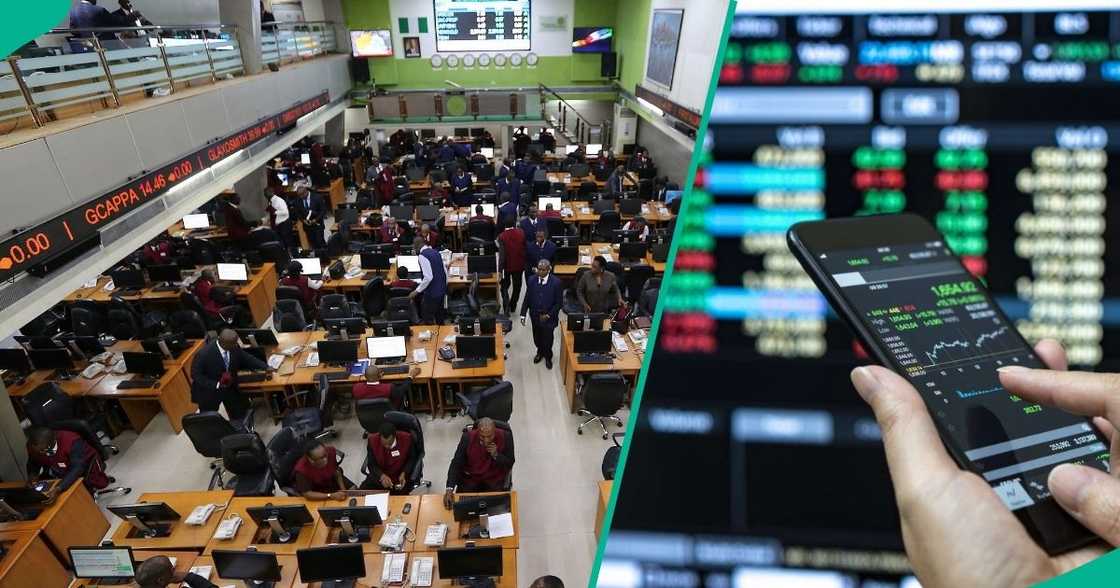
The Nigerian stock market experienced a turbulent and distressing week, as panic gripped investors following a statement credited to former United States President Donald Trump. Between November 3 and November 7, 2025, the Nigerian Exchange Limited (NGX) witnessed one of its worst trading weeks in recent times, with a total market loss estimated at N2.8 trillion. The losses, which stretched across all five trading sessions, reflected growing investor uncertainty and widespread sell-offs fueled by both local and international anxieties.
The equity market capitalization tumbled from N97.7 trillion to N94.9 trillion, while the All-Share Index (ASI) fell sharply by 2.99 percent, closing at 149,524.81 points, down from the previous week’s 154,126.46 points. This steep decline was not only a reaction to domestic economic factors but also linked to Trump’s recent threat toward Nigeria, which appeared to have shaken the confidence of foreign investors and local traders alike.
Trading opened on Monday with losses amounting to N245.88 billion, setting a gloomy tone for the rest of the week. On Tuesday, the situation worsened as the market recorded another N611.96 billion decline. By Wednesday, the sell-off intensified dramatically, with investors losing an alarming N1.31 trillion in a single day — the worst daily performance of the week and one of the steepest recorded in recent years. The negative momentum continued on Thursday, when the market slipped further by N347.75 billion. Friday closed the week on a weaker note as investors shed another N318.78 billion, rounding up the total five-day loss at a staggering N2.8 trillion.
Market activity also slowed notably during the period under review, showing a decline in both volume and value of transactions. Investors traded 3.575 billion shares valued at N107.011 billion across 146,429 deals, compared to the previous week’s 7.479 billion shares worth N145.429 billion exchanged in 159,487 deals. The reduction in trading volume and value highlighted the waning confidence among investors who appeared to be shifting to a more cautious stance amid fears of worsening economic instability.
The financial services industry maintained its dominance in trading activities, accounting for a major portion of market turnover. The sector recorded 2.946 billion shares valued at N65.904 billion across 62,817 deals. Fidelity Bank Plc, FCMB Group Plc, and Aso Savings & Loans Plc were the most active equities, jointly accounting for 1.288 billion shares worth N19.3 billion in 11,536 deals. Their combined performance represented 36.03 percent of total market volume and 18.08 percent of total value.
In the area of price movement, 20 equities appreciated in value, a decline from 29 recorded the previous week. On the other hand, 75 equities declined, an increase from the 70 that fell the previous week, while 51 remained unchanged. NCR (Nigeria) Plc emerged as the top gainer for the week with a 20.94 percent price appreciation, followed by Eunisell Interlinked Plc with a 20.17 percent gain, and Union Dicon Salt Plc, which posted a 9.93 percent rise. Conversely, Sovereign Trust Insurance Plc led the list of losers, dropping by 28.21 percent, followed by C & I Leasing Plc with a 20.16 percent fall, while Skyway Aviation Handling Company Plc lost 18.99 percent over the same period.
The decline in stock performance underscores deepening concerns over Nigeria’s economic direction. Analysts point to market volatility, foreign exchange challenges, and the global perception of Nigeria’s stability as key drivers of the bearish trend. The situation was further aggravated by political developments involving former U.S. President Donald Trump, who recently designated Nigeria as a “Country of Particular Concern” following allegations of religious persecution and human rights violations. In his statement, Trump reportedly threatened to take military action against Nigeria if such allegations continued — a comment that triggered international debate and widespread reactions across Africa.
Market analysts say Trump’s remarks may have spooked foreign portfolio investors who play a significant role in Nigeria’s capital market. The fear that such a statement could result in diplomatic tension or economic sanctions contributed to the rapid withdrawal of funds and the widespread sell-offs recorded throughout the week. Economic experts also noted that Nigeria’s already fragile macroeconomic environment, characterized by inflationary pressures, a volatile exchange rate, and reduced foreign inflows, left the market highly sensitive to external political shocks.
Despite the grim performance, some investment experts have advised investors not to panic, urging them instead to view the decline as an opportunity to buy undervalued stocks with long-term potential. According to some analysts, market corrections of this nature are cyclical and often followed by gradual recovery once external uncertainties begin to settle. They emphasized the need for the federal government to take proactive steps in restoring investor confidence, improving the business climate, and reassuring foreign partners of Nigeria’s economic resilience and political stability.
The Nigerian capital market remains a barometer of investor sentiment, and the week’s developments once again demonstrated the extent to which global political statements can influence domestic markets. While the NGX and regulatory authorities continue to monitor the situation, the coming weeks will determine whether the market can recover from the current downturn or if investors will remain cautious in the face of ongoing uncertainty.

