

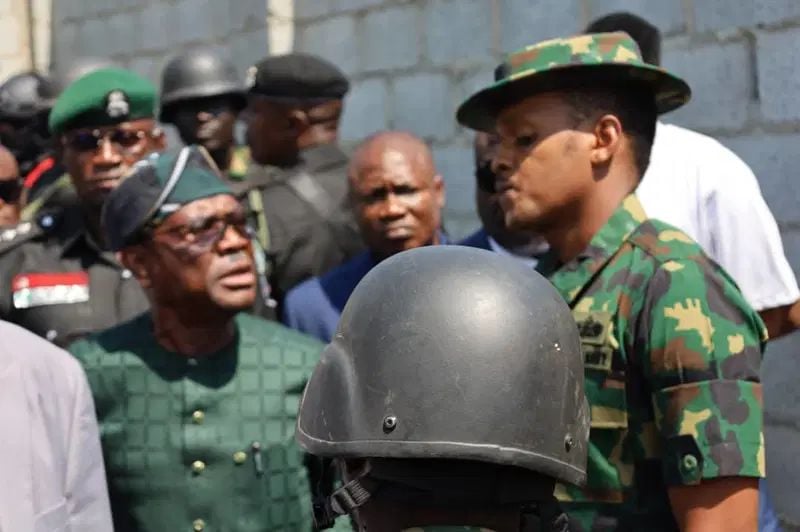
A Senior Advocate of Nigeria (SAN) and constitutional law scholar, Prof. Sebastine Hon, has strongly criticized the conduct of Naval Officer A.M. Yerima, who was involved in a public confrontation with the Minister of the Federal Capital Territory (FCT), Nyesom Wike, describing the officer’s behavior as unlawful and a clear violation of Nigeria’s constitutional order.
In a detailed Facebook post on Wednesday, Hon expressed disappointment over Yerima’s decision to obstruct Minister Wike from accessing a parcel of disputed land in Abuja. The legal luminary emphasized that no military or paramilitary officer has the authority to act contrary to the civil government or to hide behind “superior orders” to justify misconduct.
He stated, “Brushing sentiments aside, I condemn in totality the actions of the naval officer who prevented the FCT Minister from entering the land, pretending to act on the instructions of a superior. Even within military circles, obedience to superior orders has clear limitations, and the Supreme Court of Nigeria has made this clear.”
Citing landmark judgments including Onunze v. State (2023) and Nigeria Air Force v. James (2002), Hon reiterated that the country’s apex court has established that soldiers and officers are not compelled to obey illegal or unjust orders. He stressed that Yerima’s involvement in protecting a private property allegedly belonging to a retired naval officer was outside the scope of any lawful military engagement.
“The illegality stems from the fact that no military law authorizes a serving officer to guard a private site, especially one tied to his former superior. If there were legitimate security concerns, the appropriate action would have been to notify the police, not for the navy to take over a construction site,” Hon added.
The constitutional lawyer further explained that under Section 297(2) and 302 of the 1999 Constitution (as amended), the Minister of the Federal Capital Territory holds delegated authority from the President of Nigeria on all land-related matters within Abuja. “By law, Wike was acting as the representative of the President — the Commander-in-Chief of the Armed Forces. Any attempt to obstruct him was not only a breach of protocol but an affront to the authority of the Commander-in-Chief himself,” he explained.
While admitting that Wike is often perceived as a tough and confrontational leader, Hon maintained that the minister’s actions in this instance were legally justified. “His methods may appear forceful, but his actions were within the law. The officer who confronted him, on the other hand, breached both the Constitution and the Armed Forces Act,” he said.
Quoting Section 114 of the Armed Forces Act, Hon highlighted that military personnel who commit civil offences can be tried and punished under both civil and military laws. “The naval officer could face a court-martial for obstructing a public officer from performing his duties,” he added.
Hon also cautioned Nigerians against glorifying insubordination, warning that doing so could embolden rogue security operatives. “If such behavior goes unpunished, it could set a dangerous precedent — one that empowers uniformed men to challenge civil authority. Tomorrow, it might not just be Wike; it could be any civilian facing military intimidation,” he warned.
The statement came amid growing public debate following a viral video showing Wike in a heated exchange with naval personnel at Plot 1946, Gaduwa District, Abuja. The minister and his team from the Federal Capital Territory Administration (FCTA) were reportedly enforcing a stop-work order due to the developers’ lack of valid documentation.
In the video, Wike could be seen accusing the naval personnel of protecting land grabbers and vowing not to be cowed by anyone, regardless of their position or connections.
After the confrontation, Wike told reporters that he personally intervened after learning that uniformed officers had driven away FCTA officials. “I was informed that the military came to chase away our enforcement team. I had to come here myself to confirm. It is unfortunate that a serving officer would obstruct lawful government operations. No one is above the law,” Wike declared.
He insisted that the FCTA would continue to reclaim public lands illegally occupied by private interests, promising that intimidation or blackmail would not deter his administration from enforcing Abuja’s master plan.
The incident has continued to generate reactions across Nigeria, with legal experts, civil rights activists, and political observers calling for a full investigation into the conduct of the naval officer and the chain of command that allowed the confrontation to escalate.

